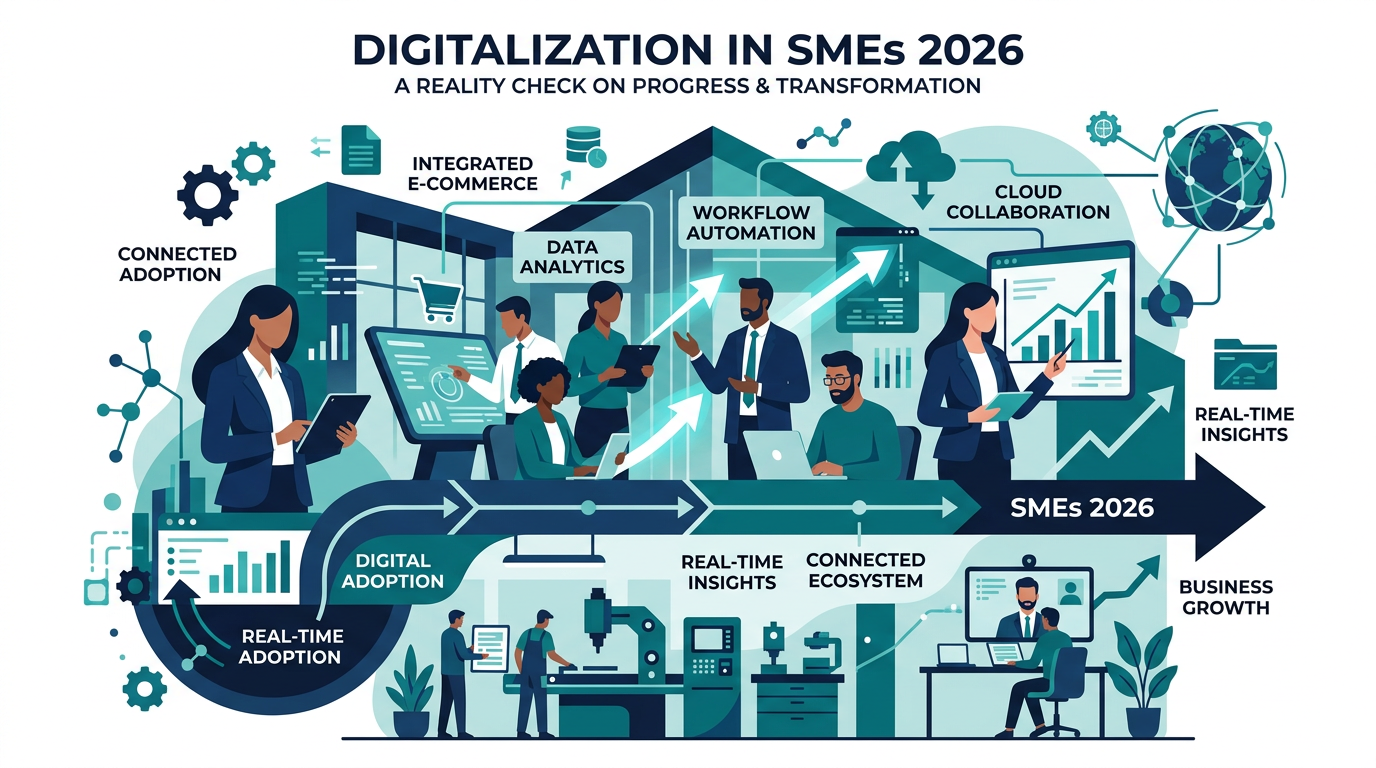
Every year the same picture: studies urge the urgency of digitalization in mid-sized companies, funding programs are launched, keynotes are held – yet many companies remain stuck in digital mediocrity. 2026 is a turning point. Not because the technology is new, but because competitive pressure leaves companies no choice. Those who don't digitalize now will lose – not someday, but now.
Digitalization in SMEs 2026: Where German Companies Really Stand
The hard numbers paint a nuanced picture. The Federal Ministry of Economics' Digitalization Index shows: Germany's Mittelstand has moved – but not fast enough.
- 62% of mid-sized companies use basic cloud services in 2026 (2022: 41%).
- 38% use at least one AI application productively (2022: 12%).
- Only 14% have a documented digital strategy that's regularly updated.
- 71% cite the skills shortage as the biggest barrier to digitalization.
- 55% see data privacy requirements as a brake.
The core problem: Many companies digitize, but they don't transform. They replace paper forms with PDFs and call it digitalization. True digital transformation means fundamentally rethinking business models, processes, and customer relationships.
The 4 Megatrends Defining SMEs in 2026
Megatrend 1: AI Becomes a Standard Tool
Artificial intelligence is no longer an experimental topic in 2026 – it's becoming a standard tool. Like Excel in the 90s and cloud computing in the 2010s, AI is becoming part of basic business equipment.
In concrete terms:
- AI assistants are being integrated into common business software – from email programs to ERP systems to industry solutions. Cross-cutting themes: AI process automation and back-office automation.
- Generative AI automates text creation, reporting, and sales automation from proposal to customer communication.
- Predictive analytics makes maintenance planning in industrial automation, demand forecasting, and sales management data-driven.
- For personnel processes (applicant management, onboarding), HR process automation pays off particularly quickly; in the real estate sector, AI is fundamentally changing property management and marketing.
The key difference from previous years: barriers to entry have dropped dramatically. For your first productive AI deployment today, you need neither a data science team nor a six-figure budget. The question is no longer "whether AI" but "where first."
Megatrend 2: Cloud-First Becomes Cloud-Smart
The initial cloud euphoria is giving way to a more pragmatic approach. Companies realize: not everything needs to be in the cloud, and not every cloud solution is the best choice.
Cloud-Smart means:
- Deliberately distributing critical data and processes between on-premise, private cloud, and public cloud.
- Multi-cloud strategies that reduce dependencies on individual providers.
- Clear cost management, because the cloud's "pay-as-you-go" promises can become expensive with uncontrolled growth.
- EU sovereignty requirements: Gaia-X and European cloud initiatives are gaining importance.
Megatrend 3: Cybersecurity as Business Risk #1
As digitalization increases, so does the attack surface. In 2025, 46% of German mid-sized companies were affected by at least one significant cyberattack. The average damage: €200,000 – an existential threat for smaller companies.
What matters in 2026:
- NIS2 Directive: The EU-wide cybersecurity directive now also affects mid-sized companies in critical sectors. Violations can be penalized with up to €10 million.
- Zero-trust architectures: "Trust nobody" is becoming the standard security concept.
- AI-powered threat detection: Ironically, you need AI to defend against AI-powered attacks.
- Cyber insurance: Insurers are setting increasingly higher requirements for IT security as a prerequisite for coverage.
Megatrend 4: Data as a Strategic Asset
Data is the foundation of every digitalization – and simultaneously the biggest weakness of many mid-sized companies. In 2026, data governance definitively becomes mandatory.
- Data quality: "Garbage in, garbage out" applies to AI too. Without clean, consistent data, every AI project fails.
- Breaking down data silos: ERP, CRM, production, finance – when these systems don't communicate, data potential remains untapped.
- Data literacy: Not just IT needs to understand data. Business departments must learn to use data as a decision-making basis.
- EU Data Act: New regulations on data access and data portability are changing the rules – especially in B2B.
Beyond Efficiency Gains: Digitalization as a Growth Engine
The most common mistake in SME digitalization: it's only viewed as a cost reduction tool. Of course, automation saves time and money – but that's only half the truth.
Companies that approach digitalization strategically additionally achieve:
- New business models: Digital services, platform models, data-based products – digitalization opens revenue streams that wouldn't be possible without technology.
- Better customer experiences: Self-service portals, real-time transparency, personalized communication – customers expect digital interaction options, even in B2B.
- Employer attractiveness: Digital workplaces, flexible processes, and modern tools are a decisive factor in the war for talent.
- Resilience: Digitalized companies respond faster to crises, supply chain problems, and market changes.
Your 90-Day Action Plan for Digitalization
Enough analysis – time to act. This 90-day plan advances your company measurably in three months, without overwhelming your workforce or blowing your budget.
Days 1–30: Assessment and Quick Wins
- Weeks 1–2: Conduct a structured digitalization assessment. Where do you stand? Which processes are manual, error-prone, or slow? What data do you have – and at what quality?
- Week 3: Identify three quick wins – processes that can be automated in 4–8 weeks with immediately measurable ROI.
- Week 4: Form a small digitalization team (3–5 people, cross-functional). Define the first pilot project with clear KPIs.
Days 31–60: Implement First Pilot Project
- Weeks 5–6: Technical implementation of the first quick win. Example: automation of incoming invoice processing or AI-powered email classification.
- Week 7: Testing and feedback round with affected employees.
- Week 8: Go-live and success measurement. Document results for internal communication.
Days 61–90: Scaling and Strategy
- Weeks 9–10: Evaluate the pilot project. Document lessons learned. Communicate successes internally – nothing convinces more than measurable results.
- Week 11: Start the second and third quick wins based on insights from the pilot project.
- Week 12: Create a 12-month digitalization roadmap with priorities, budgets, and responsibilities.
Conclusion: 2026 Is the Year of Decision
Digitalization in mid-sized companies in 2026 is no longer a vision – it's a necessity. The good news: it's never been easier or more affordable to start digitalization. The bad news: companies that don't act now will find it increasingly difficult to close the gap.
The most important step is the first one. Our free AI audit gives you clarity within days about where your biggest digitalization levers lie and how to achieve measurable progress in 90 days – pragmatic, affordable, and without buzzword bingo.
→ Request your free ProcessCheck at ProzessAutomatisierung.ai and accelerate your digitalization.