The headlines promise a lot: artificial intelligence is supposed to revolutionize processes, cut costs, and enable new business models. But the reality in Germany's Mittelstand tells a different story. According to a McKinsey study, roughly 70% of all AI projects fail – not because of the technology, but because of a missing strategy. Anyone who wants to develop a successful AI strategy for mid-sized companies needs more than a pilot project: they need a clear plan.
AI Strategy for SMEs: The Status Quo Is Sobering
The numbers are clear – and alarming. A recent Bitkom survey shows that while 43% of mid-sized German companies are experimenting with AI applications, only 7% have successfully integrated and scaled AI into their core processes. That means 93% are either stuck in the pilot phase, have abandoned projects, or haven't started at all.
The reasons are varied but almost always strategic in nature:
- Missing objectives: AI is deployed because it's "modern" – not because it solves a specific business problem.
- Isolated pilot projects: A chatbot here, a data analysis tool there – with no connection to the overall strategy.
- Data silos: CRM, ERP, and accounting don't talk to each other. Without clean data, AI can't function.
- Skills gaps: Neither the IT department nor management knows where to start.
- Unrealistic expectations: Leadership expects results within weeks – realistic AI projects take months.
The 5 Phases of a Successful AI Strategy
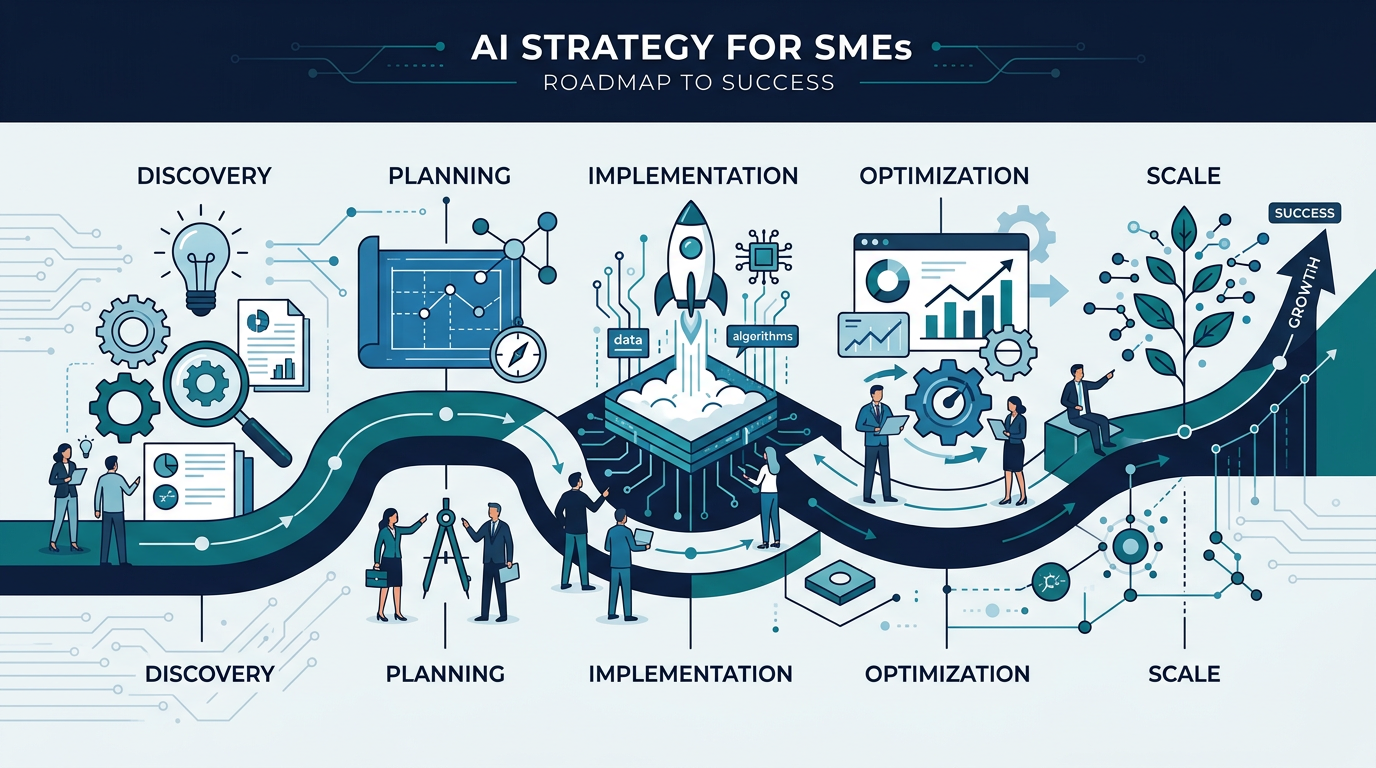
A robust AI strategy for mid-sized companies doesn't follow a random approach. Companies that have successfully scaled AI typically go through five phases. This roadmap has proven itself across dozens of SMEs.
Phase 1: Assessment – Where Do You Really Stand?
Before investing in technology, analyze your current state. Which processes run manually? Where do the highest costs from inefficiency arise? What data do you already capture – and at what quality?
A structured ProcessCheck typically uncovers the three to five areas where AI has the greatest leverage within just a few days. Typical candidates: proposal creation, invoice processing, customer communication, and quality assurance.
Phase 2: Identify Quick Wins
The biggest mistake is starting with the most complex project. Successful companies begin with quick wins – use cases that deliver measurable results in 4 to 8 weeks. Good candidates meet three criteria:
- High manual effort (repetitive tasks)
- Structured or semi-structured data already available
- Clearly measurable ROI (time savings, error reduction, cost cuts)
An example: Automated processing of incoming invoices saves an average of 75% of processing time and reduces errors by over 90%. These are results that convince the entire organization.
Phase 3: Pilot Project with Clear KPIs
Now it gets concrete. Select one use case from Phase 2 and implement it as a pilot project. The key: define clear KPIs upfront. Not "let's try AI," but "we'll reduce proposal creation time from 4 hours to 30 minutes."
Best practices for the pilot project:
- Small, dedicated team (3–5 people from the business unit + IT)
- Fixed timeframe: maximum 8–12 weeks
- Weekly progress measurement against defined KPIs
- Documentation of all learnings – including failures
Phase 4: Scaling and Integration
If the pilot succeeds, the real work begins: integrating into existing systems and processes. This is where most companies fail because they underestimate the organizational component.
Successful scaling means:
- System integration: The AI solution must communicate seamlessly with ERP, CRM, and other legacy systems.
- Process adaptation: Existing workflows must be adjusted – including responsibilities and approval processes.
- Change management: Employees must be trained and involved. AI that nobody uses delivers no ROI.
- Governance: Clear rules for data quality, privacy, and ethical boundaries.
Phase 5: Continuous Optimization
AI isn't a project with a beginning and end – it's a continuous process. The best companies have an AI competence center or at least a dedicated AI lead who identifies new use cases, optimizes existing models, and regularly aligns the AI strategy with changing business requirements.
Closing the Skills Gap: How to Build AI Know-How
One of the biggest barriers to an AI strategy in mid-sized companies is the talent shortage. Data scientists and AI engineers are expensive and hard to find. But there are pragmatic ways to close the skills gap:
Build Internal Champions
Identify tech-savvy employees in business units and train them as AI champions. These people don't need to program models – they need to understand which problems AI can solve and how to formulate use cases. A two-day foundational training is often sufficient.
Use External Partners Strategically
For technical implementation, you need partners who understand the Mittelstand and offer a clear portfolio of consulting and implementation services. Look for:
- Industry experience and references from mid-sized companies
- Transparent pricing models (no hidden license costs)
- GDPR-compliant solutions with data processing in the EU
- Knowledge transfer over dependency: the partner should empower your team, not lock you in permanently.
Leverage Low-Code/No-Code Platforms
Modern AI platforms allow you to build AI-powered automations without deep programming knowledge. Tools like Make, n8n, or Microsoft Power Automate with AI modules significantly lower the barrier to entry.
Finding Quick Wins: The Best Starting Points for SMEs
If you want to start your AI strategy tomorrow, begin here. These five use cases offer the best effort-to-impact ratio:
- Email classification and routing: AI automatically sorts incoming emails by urgency, topic, and responsible department. Typical time savings: 2–3 hours per employee per week.
- Proposal creation: Automatic generation of proposals based on historical data, price lists, and customer profiles. Reduction from 4 hours to 15–20 minutes.
- Invoice processing: OCR and AI extract data from incoming invoices, match them with orders, and prepare the posting. Error rate drops from 5–8% to under 1%.
- Customer support automation: AI-powered chatbots answer 60–80% of standard inquiries instantly around the clock.
- Quality control: Image recognition AI identifies product defects faster and more reliably than manual inspection.
From Strategy to Execution: Your Next Step
An AI strategy for mid-sized companies doesn't have to be complex – but it must exist. Companies that introduce AI haphazardly join the 70% of failed projects. Companies that proceed methodically belong to the 7% that have successfully scaled AI.
The difference isn't budget, and it isn't technology. It's methodology.
If you want to know where the biggest levers for AI automation lie in your company, start with our free AI audit. In a structured analysis, we'll jointly identify the three to five processes where AI delivers the greatest ROI – and you'll get a concrete roadmap for implementation.
→ Request your free ProcessCheck at ProzessAutomatisierung.ai and start your AI strategy today.